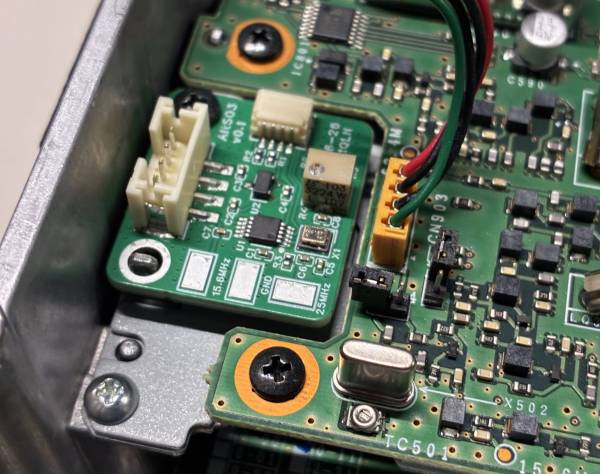
altso3
AltSO3
Programming
Micropython code for programming the MS5351M. Not yet tested.
- main.py
import machine import time I2C_ADDR = 0x60 # Default Si5351A I2C address I2C_SDA_PIN = 8 # RP2040 GP8 I2C_SCL_PIN = 9 # RP2040 GP9 def setup_si5351(i2c): def write_reg(reg, val): i2c.writeto_mem(I2C_ADDR, reg, bytes([val])) # 1. Disable all outputs write_reg(3, 0xFF) # 2. Power down all output drivers for reg in range(16, 24): write_reg(reg, 0x80) # 3. Calculate and configure PLLA registers for 624 MHz # Multiplier: a=24, b=24, c=25 a_pll, b_pll, c_pll = 24, 24, 25 p1_pll = 128 * a_pll + int(128 * b_pll / c_pll) - 512 p2_pll = 128 * b_pll - c_pll * int(128 * b_pll / c_pll) p3_pll = c_pll write_reg(26, (p3_pll >> 8) & 0xFF) write_reg(27, p3_pll & 0xFF) write_reg(28, ((p1_pll >> 16) & 0x03) | (((p2_pll >> 16) & 0x03) << 4)) write_reg(29, (p1_pll >> 8) & 0xFF) write_reg(30, p1_pll & 0xFF) write_reg(31, (((p3_pll >> 16) & 0x0F) << 4) | ((p2_pll >> 16) & 0x0F)) write_reg(32, (p2_pll >> 8) & 0xFF) write_reg(33, p2_pll & 0xFF) # 4. Calculate and configure MultiSynth 0 registers for divide-by-40 # Divider: a=40, b=0, c=1 a_ms, b_ms, c_ms = 40, 0, 1 p1_ms = 128 * a_ms + int(128 * b_ms / c_ms) - 512 p2_ms = 128 * b_ms - c_ms * int(128 * b_ms / c_ms) p3_ms = c_ms write_reg(42, (p3_ms >> 8) & 0xFF) write_reg(43, p3_ms & 0xFF) write_reg(44, ((p1_ms >> 16) & 0x03) | (((p2_ms >> 16) & 0x03) << 4)) write_reg(45, (p1_ms >> 8) & 0xFF) write_reg(46, p1_ms & 0xFF) write_reg(47, (((p3_ms >> 16) & 0x0F) << 4) | ((p2_ms >> 16) & 0x0F)) write_reg(48, (p2_ms >> 8) & 0xFF) write_reg(49, p2_ms & 0xFF) # 5. Connect MS0 to CLK0, Power Up, Integer Mode, PLLA Source, 8mA drive # 0x4F = 0b01001111 write_reg(16, 0x4F) # 6. Reset PLLA write_reg(177, 0x20) # 7. Enable CLK0 write_reg(3, 0xFE) print("Success: Si5351A configured to output 15.6 MHz on CLK0 in RAM.") def burn_to_nvram(i2c): """ WARNING: The Si5351A NVRAM is One-Time Programmable (OTP). This permanently burns the current RAM configuration into the chip. """ print("⚠️ WARNING: Initiating NVRAM burn sequence...") print("This is a One-Time Programmable (OTP) operation!") time.sleep(3) # Give user a chance to interrupt execution (Ctrl+C) if accidental def write_reg(reg, val): i2c.writeto_mem(I2C_ADDR, reg, bytes([val])) # Write 0xC0 to register 161 (NVM_WRITE) to trigger NVRAM burn write_reg(161, 0xC0) time.sleep(1) # Wait for NVM burn to complete print("✅ NVRAM burn sequence completed. This configuration is now permanent.") if __name__ == "__main__": # Initialize I2C bus 0 i2c = machine.I2C(0, scl=machine.Pin(I2C_SCL_PIN), sda=machine.Pin(I2C_SDA_PIN), freq=400000) # 1. Configure the RAM first to test the output setup_si5351(i2c) # 2. ⚠️ DANGER ZONE: Uncomment the line below ONLY AFTER verifying the 15.6 MHz # output with an oscilloscope or frequency counter. # burn_to_nvram(i2c)
altso3.txt · Last modified: by admin